Ballet mécanique in Cambridge
On Sunday last I had the almost unique opportunity to attend a performance of George Antheil’s Ballet mécanique at the West Road Concert Hall in Cambridge, part of the Cambridge Music Festival. The concert also marked the 100th anniversary year of the publication of the Futurist Manifesto.
My attention was drawn to the event by my friend Paul Lehrman, whom I knew originally as a brilliant journalist who used to write for me when I was Editor of Studio Sound back in the 1980s. Since then we’ve done a bunch of stuff together including music for KPM Music Library and much more.
Today, Paul is a music professor based at a university in the Boston area, and he has made quite a name for himself for his realisation of a version of Antheil’s work which calls (at least in its full version) for a percussion orchestra of three xylophones, four bass drums and a tam-tam (gong); two live pianists; seven or so electric bells; a siren; three aeroplane propellers; and 16 synchronized player pianos. As you can imagine, it’s a flamboyant, controversial, downright noisy piece of avant-garde music.
This large-scale version of the piece, composed around 1923, was never performed in Antheil’s lifetime, apparently because the friend of Antheil’s who told him you could sync up 16 player pianos was wrong: the technology of the time did not allow it. Paul Lehrman, however, was commissioned by music publishers G. Schirmer to realise the work for the 16 player pianos called for in the original manuscript, using modern digital technology in the form of digital player pianos, MIDI, and samples for the aircraft propellers.
This he did, and the first performance took place at the University of Massachusetts, Lowell, exactly ten years ago (on 18 November, 1999). Since then it’s been performed on numerous occasions around the world. You can read more about it, and about Antheil, at Paul’s site which you can find here at antheil.org.
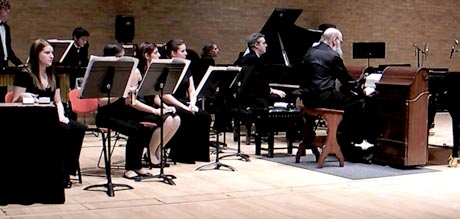
Cambridge: rattles, pianos, Pianola and electric bells
This was not the version performed at West Road on Sunday, however. That was a somewhat more restrained version performed on this occasion on a single Pianola plus two live pianists, three xylophones, drums and percussion, rattles (performing the propeller parts), two electric doorbells and a hard-cranked siren. Musically, it was a version first performed in 1927 (and not very often thereafter). Paul asked me if I could go along and interview Paul Jackson, the conductor, experience the performance and find the answers to some questions about this particular version.
This sounded as if it could be enormous fun (which indeed it was) so I duly turned up for the event, Music hard and beautiful as a diamond, part of the 2009 Cambridge Music Festival, consisting of three works performed by Rex Lawson on Pianola, Julio d’Escriván on iPhone, the Anglia Sinfonia, Anglia Voices and MEME, conducted by Paul Jackson.
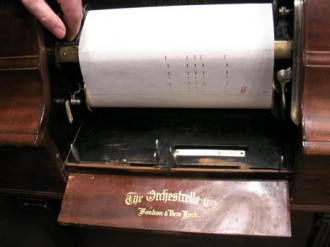
Pianola mechanism with roll
The concert itself was preceded by a 45-minute presentation by Lawson and d’Escriván about the Pianola and the iPhone as an instrument respectively (d’Escriván’s piece started the evening). I was particularly interested in Lawson’s exposition on the Pianola.
The Pianola is quite different from the Reproducing Piano and is not even truly the stuff of “player pianos” in saloons in cowboy movies, though they all use a “piano roll” to provide the notes. In the case of the Reproducing Piano, the roll contains not only the notes but all the tempo, expression and other aspects of an actual performance. Thus the big selling point of these systems, therefore, was to get famous performers and composers to perform their works, which could then be flawlessly reproduced at home.
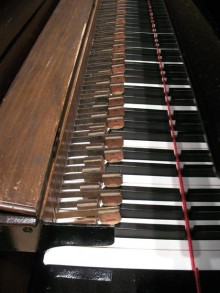
Actuators in position over the Steinway keyboard
The Pianola, on the other hand, began life as a “cabinet player” – a box on castors that you wheel up to a conventional piano (a Steinway grand in the case of the Sunday performance) and lock into place so that its felt-covered actuators can press the keys. It’s powered by pedals, which drive the roll and also force air through the holes in the roll to sound the notes. By changing the pressure on the pedals (eg by stamping on them) you can also change the loudness of the notes – in other words, give the performance dynamics – that can be applied to different parts of the range. There’s also a tempo slider – and even technology that picks out the top line automatically.
This is all rather important, because the piano roll for a Pianola contains only the notes – the player determines the tempo and expression (in a solo performance, for example, including visual cues printed or written on the roll). Thus a Pianola performance actually is a performance, and not a playback. Yes, the notes are provided, but the expression is manually applied.
Pianola rolls were not created by playing the instrument and recording what the performer did, as in the case of the Reproducing Piano. Instead, they were created simply from the score. Imagine a MIDI sequence created in step-time with no velocity information and you get the idea.
Most people couldn’t be bothered to learn the subtle nuances of Pianola performance, however, and simply pedalled away, giving the instruments a rather lifeless, mechanical reputation which was entirely undeserved. Ultimately, mechanisms were built into (usually upright) pianos – and hence the player pianos in the bars depicted in the cowboy movies aforementioned.
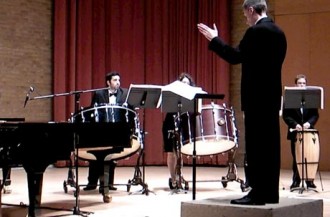
The drum section and Paul Jackson, Conductor
Rex Lawson, who performed the Pianola part in Sunday’s concert, is a leading expert on the instrument, and his presentation disposed of quite a few myths, especially when it came to the performance of Ballet mécanique. The fact that the player controls the tempo means that the Pianola can actually follow a conductor in the conventional way – the Pianola does not have to set the tempo and have every other player sync to it. In Paul Lehrman’s performances, in contrast, the MIDI replay system that drives the player pianos also generates a click track that everyone follows.
Similarly, the fact that you can control the dynamics of the Pianola means that the instrument does not simply bash out all the notes at full blast. As a result, primarily, of these two factors, Ballet mécanique takes on a whole new degree of light and shade. Yes, it’s still a cacophony of 20s avant-garde exuberance, but it takes on a good deal of additional subtlety.
Lawson feels that the piece is designed to be played on these Edwardian instruments rather than modern digital systems, and that you need to actually perform the Pianola part – as he puts it, you need to “sweat”. However, he is interested in getting some fellow Pianola-owning friends together to perform the work on four Pianolas synchronised as far as tempo is concerned.
Lawson thinks the idea of 16 player pianos was Antheil showing off, that it was probably originally intended for four live pianists, and that the big problem with performing it at the time was that there were not nearly enough players in Paris who knew the subtleties of the Pianola and how to use its tempo and expression capabilities. In his planned 4‑Pianola performance, he would set the tempo at his Pianola and the others would follow the tempo he set by using stepper motors to sync them to his unit. Which sounds like a great idea, though there might be issues due to stretching or slippage of the rolls: it might need sprocketed piano rolls, which did actually exist.
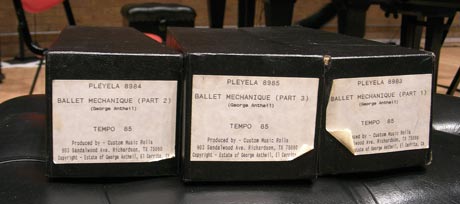
The boxes for the three pianola rolls
The Sunday performance of the single-Pianola version used three piano rolls, and to allow changing them the performance was split into three movements.
The performance, for me, shed new light on a fascinating composition from the 1920s. A radically different interpretation from Paul Lehrman’s, it suggests interesting possibilities for a Lawson/Lehrman collaboration.
• The programme also included Grand Pianola Music by John Adams (no Pianolas involved), and Julio d’Escriván’s ingenious and expressive Ayayay! Concerto for iPhone, Pianola and orchestra.